

Some years ago, I wrote about the Monte Carlo player, where a puzzle player surrenders and falls back on brute force methods – using random explorations into the depths of probability space to find a way out.
I accepted puzzles can require some Monte Carlo exploration to reach epiphany but this is more like echo sounding, an attempt to reveal the structure beneath the puzzle’s visible surface.
However, if echo sounding solves a puzzle before you’ve understood it, it feels like you muddled through instead of bringing your smarts to bear.
This frequently happens during the early levels of a puzzle game; you’re fumbling around but the solution involves a mere handful of turns. You turn a corner – the level is done. Oh. This even happened to me once during a stream of Bonfire Peaks (Corey Martin, 2021) a few years ago. I was just shifting things around and boom, I accidentally found the trick to solving the level and 20 seconds later it was done. Oh.
This can happen with larger puzzles as well and, while it’s not exactly brute force, I find little satisfaction when the solution emerges from “puzzle muddling” like this.
And the hazard of the echo sound solution is that a player continues to the next level without reflection. The only way to get better at a puzzle game is deliberate practice and to understand what you have done. Accidental solution can generate its own forward momentum, beckoning players ever onward. And some games rush players along to the next challenge. Can’t leave the player waiting! Things to do! Places to go! Puzzles to solve!
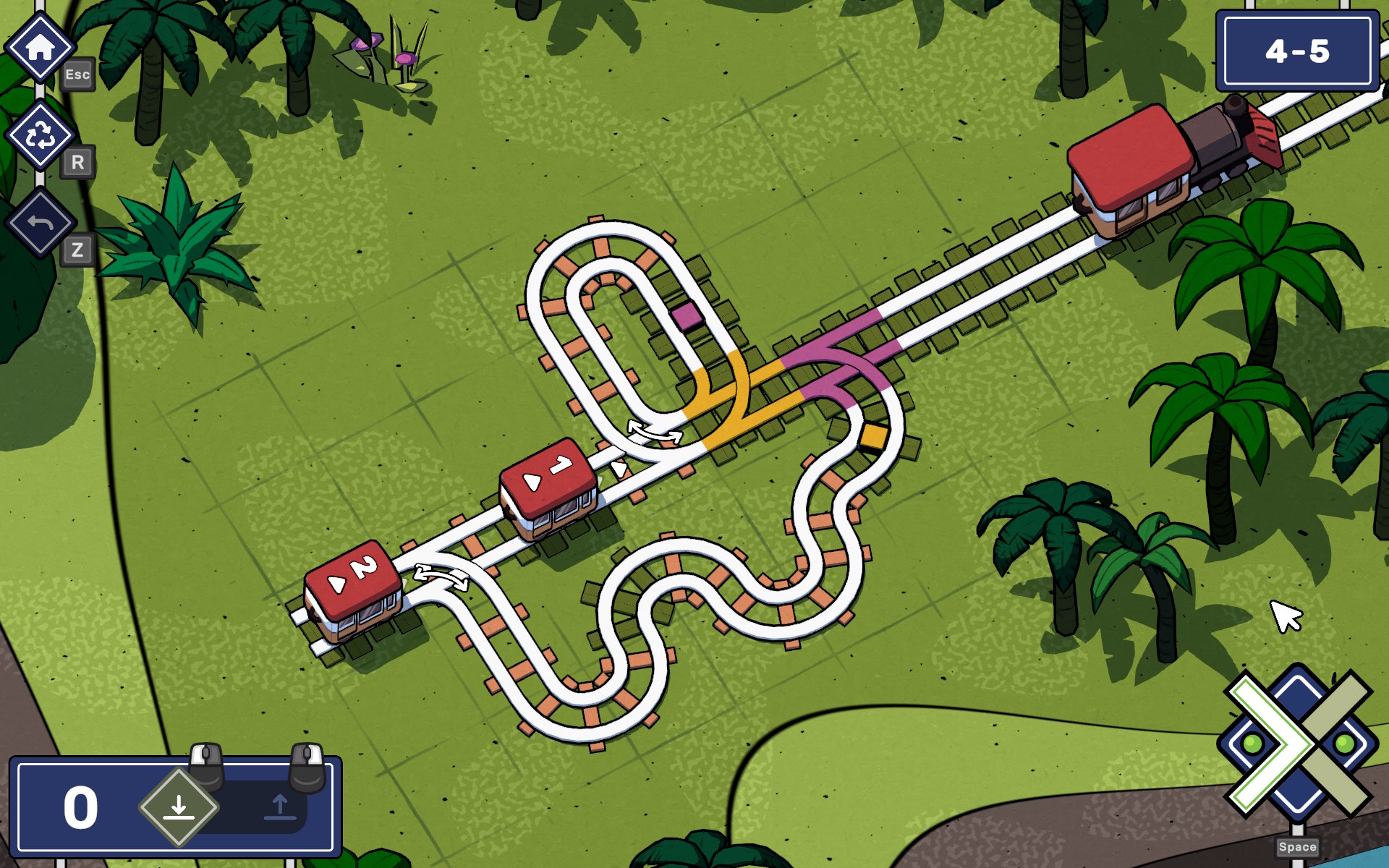
I had a particular problem with Railbound (Afterburn, 2022) whose levels were predominantly small and the levels often fell to echo sounding. When I reached level 4-5, I was completely stumped; it involved a couple of flipping track pieces and I couldn’t plot a path to success. Many of the previous levels had been so greased that I felt I had not learnt anything. Eventually, Monte Carlo liberated me.
Earlier this year, I became hooked on SokoChess (Daisy Games, 2022). Like Sokoban, you have to fill certain spaces to complete a level, but here it’s chess pieces and there are opposing pieces that will capture yours if you step in their way.
Although engrossing, it has plenty of small levels, meaning I’d frequently muddle into a solution instead of figuring out the puzzle’s secret.
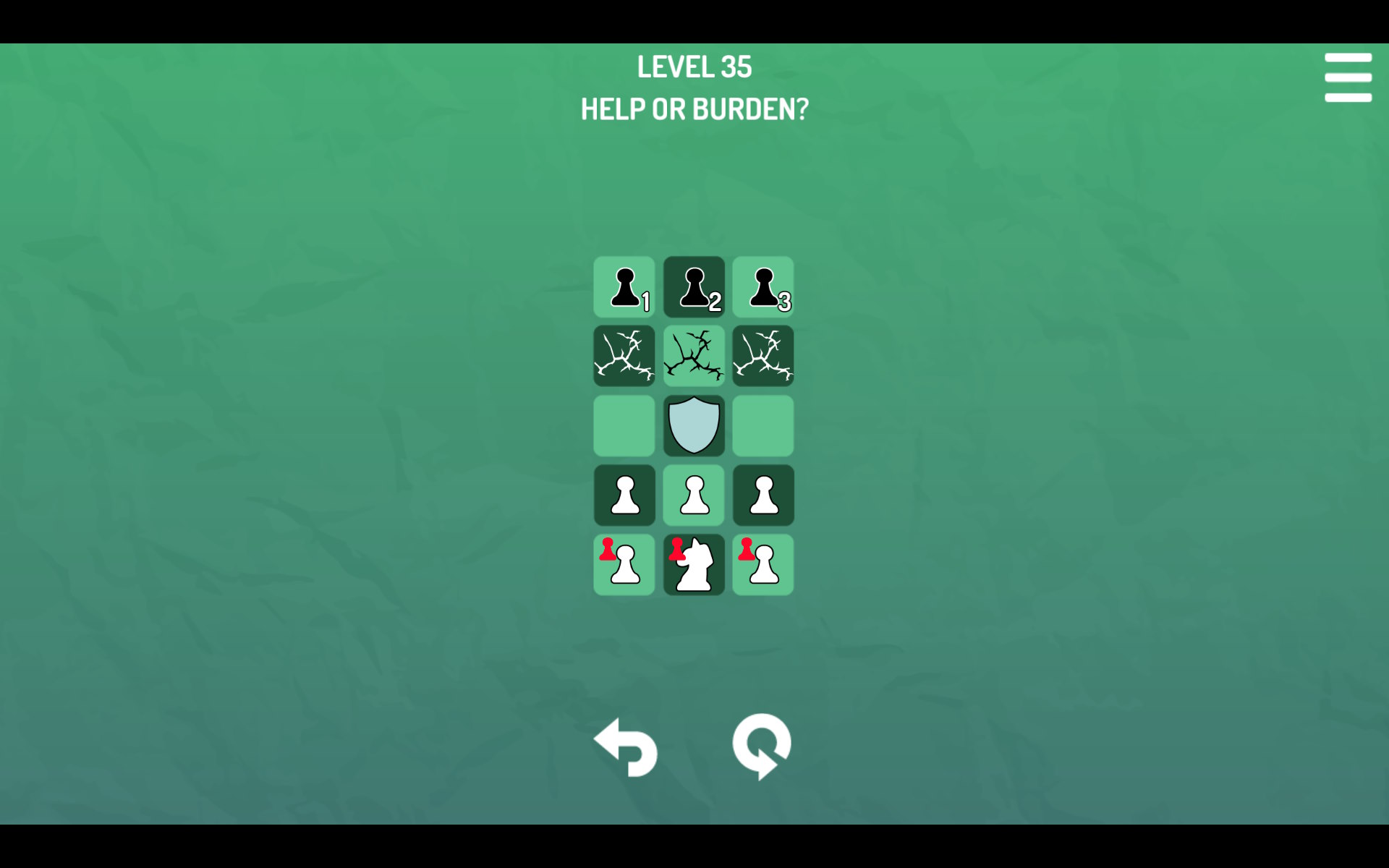
I asked the developer, Martin Firbacher, about the design of SokoChess.
“In most Sokoban inspired titles you only control one character,” he told me. “However SokoChess puts many pieces at your disposal and they all move in different ways. This means movement is much more complex to plan. I like playing Chess but I am bad at it. However, from watching and learning from some of the high level games, I realised that a lot of Chess mastery comes from planning and memorization, hence why Grandmasters start training early in their childhood.
“This also ties to why computers play Chess so differently than us humans. These days there is no limit to a computer’s capability to remember and plan their moves and think about their opponent’s possible reactions. This is a part of this issue.”
Firbacher recognised some of the larger levels would lead to Monte Carlo play. “In [the larger] levels the average person just simply can’t plan ahead enough and they will have to trial and error or even guess. Now, of course, this could be negated by having smaller and more straightforward levels and I think that many of the early levels are good at this.”

While I was perturbed about muddling through the smaller puzzles in SokoChess, Firbacher was more laid back. “I want people to have a good time with my games. If they enjoy ‘muddling’ around, so be it! If they want to min-max every single level, that’s fine with me too, more power to them!”
A possible defence against puzzle muddling is to chaperone the player via a move counter. This is tricky territory because a move counter can feel like an artificial constraint on the player. Although sometimes it’s a genuine puzzle constraint like recent Early Access release Trans Neuronica (Evidently Cube, 2023) where the obvious solution needs more moves than the designer has allotted you.
Firbacher’s previous title, Sokobos (Daisy Games, 2022), had a move counter but only as an optional goal. Had he thought of including one in SokoChess?

“Dark Sheep, the first Sokoban-like title I ever made, had a move counter. Honestly, I never gave it much thought why I put it in there. It’s something I saw other games do and many games I grew up with had some kind of stats screen after beating a level too, even non-puzzle genres like the original Doom. The reason I kept the move counter around was due to the positive reception. I had people reach out and tell me how they enjoyed beating my PARs and trying to improve their solutions.”
Firbacher wasn’t wedded to a move counter and dropped it from consideration, to see if SokoChess really needed one or not. “I think SokoChess is fine without a move counter, although that didn’t stop people asking for it. Remember, you can never please everyone! It also saved some development time which I appreciated as a mostly solo developer.”
In contrast, Wilderplace (Fitch, Bemel-Benrud & Lubanovic, 2022) goes all in. Wilderplace is much like SokoChess in that it is a turn-based puzzler with antagonists that respond to your movements.

While you have infinite moves, whenever you pick up a spirit hitchhiker, you have only three moves to get it off your back – otherwise you turn into a plant or a stone. The game suggests this isn’t a bad outcome but obviously a stone isn’t going to see any more levels! However, it limited the number of undos. We’ve previously discussed this a little in the Electron Dance comments and it seems no one loved this design choice.
“The reason Wilderplace didn’t ship with unlimited undo was to encourage players to start fresh rather than trying to muddle through,” explained Saman Bemel-Benrud from the Wilderplace team. Often, players didn’t realise they’d gone too far down a rabbit hole into an unsolvable state, so Wilderplace introduced limited undos to shepherd players towards restarting.
“Some of Wilderplace’s levels are more about narrative and mood, and these often are the most muddle-through-able – I am mostly okay with that. We tried to mix up the style of levels from section to section: some areas of the game require precise solutions, and some are more about giving the player a feeling of being a passerby to some narrative beat playing out between other characters in the game.”
However, Bemel-Benrud conceded the limited undo didn’t work out. “Based on player feedback, I don’t actually think limiting undo succeeded at this goal. It mostly just made the game more stressful. This brought me to the realisation that a big part of puzzle design is about balancing how consequential mistakes are: if there’s no room for error, players might get stressed out or miss out on the satisfaction of feeling like they found a creative solution. If there’s too much room for error, you’ll have the opposite problem: your game might be boring and players will miss out on those aha moments entirely.”
Can we design away the player solving through accident?
“I think as a designer it’s very hard to put yourself in the shoes of someone who’s just learning the basics,” Wilderplace level designer Tom Lubanovic told me. “My goal was to set up the levels so that new ideas are introduced gradually and the challenge level keeps increasing. Ideally a player will get stuck at some point and eventually reach an ‘aha!’ moment where they solve the puzzle and figure out how the game works.”
And every player is different, right? The penultimate level of Gridspech (krackocloud, 2023) kept me guessing. I formed some rules, did a bit of echo sounding, but I couldn’t get a handle on all the consequences of my choices. I was effectively Monte Carlo solving in the end – but I was later told that I’d missed the clues that would have locked in the solution without any guesswork. Is this really a design problem?

Perhaps there’s no real mitigation other than challenge progression stopping players trudging forward without learning lessons. Lubanovic hopes that players would realise they were missing something if they skipped a learning moment. “If a player ‘pushes through’ a level or two they’ll still need to reach that ‘aha’ moment but it will likely be tougher because the levels get more complex. When this happens to me while playing I usually hit a wall and will either keep trying until I solve it or look up an answer online. Very rarely will I totally give up on a puzzle game unless it isn’t fun anymore.”
I’ve often said I don’t like “dance step” puzzles like Wilderplace because of too many moving parts and being able to fully comprehend the full impact of a move. I’m learning level choreography rather than strategising. I wanted to love the game, but I found myself muddling through too many levels and getting lost whenever I returned to it.
Newsflash: Wilderplace is not the same game it was at release. The team listened to the feedback and rolled out major changes in April. Infinite undos were added as well as visual enhancements. I’m excited to go back in.

Bemel-Benrud did have a few suggestions on what might help make games more resistant to puzzle muddling. Of particular note, he felt it should be made more obvious whether or not a player has made the correct move in a multi-step solution or the wrong move that has soft-locked the puzzle and the player needs to restart or undo. (This last point is similar to what Ending developer Aaron Steed referred to as the Turn 1 Dick Move here in the Electron Dance comments.)
He also thought reducing the possibility space was key. “Fewer systems will lead to a less mushy experience. Compare the mushiness of something like Civilization to the precision of, say, Into the Breach.”
Still, it seems like it’s easier to promote muddle than find a silver bullet for it. Everything comes down to the player and the structure of the puzzle before them. I couldn’t crack Snakebird (Noumenon Games, 2015) until I approached with a different mindset. And I muddled through the entirety of Dissembler (Ian MacLarty, 2018) but only really understood it through the Daily Challenge mode, after which it became an obsession for months.
In summary? It’s as clear as muddle.
Download my FREE eBook on the collapse of indie game prices an accessible and comprehensive explanation of what has happened to the market.
Sign up for the occasional Electron Dance Newsletter and follow on Bluesky or Mastodon!


The last point about the Turn 1 Dick Move is important to me, though I would distinguish between good Turn 1 Dick Move setups and bad ones… which don’t even have to be Turn 1 Dick Moves. OK I guess maybe there’s something different going on and part of it is a matter of personal taste, that there’s a kind of muddling I don’t mind that much–like the one in that Bonfire Peaks level (Over Your Head?) in your stream. Or: why I don’t enjoy assembling things in one place and to use them in another.
The good Turn 1 Dick Move, for me, is Schmuck Bait where you do something pretty obvious in the beginning and then discover you’re stuck. Either the level seemed impossible but you could accomplish one thing, and then it’s really impossible; or there was an obvious plan which doesn’t work. (Maybe even that doesn’t work because of a rule you haven’t learned yet, like level 6 of Yugo Puzzle where you discover that the rules are not exactly those of Jelly No Puzzle–strictly that moment arrives before the Schmuck Bait on the level.) Part of what makes puzzle games fun and arrrgggh is making you think of unexpected things and this is one way to do it, realize you don’t have to start this way.
The bad kind–sometimes–is when you do a clever trick and it looks like you’re making progress but it’s sent you down a blind alley, or in order to get started you have to do something weird that isn’t obvious progress, because from there the solution is hidden behind another weird trick. Maybe you muddle your way into the first trick and then see what to do, or maybe you try one of several clever tricks and bang around with each of these serially until you hit on the one you were supposed to start with–but your time with the others was wasted. Or maybe you’re smarter than me and you say your way through both tricks from the beginning!
Illustrations from three Bonfire Peaks Lost Memories levels! Yes I have been planning this wall of rot13 for a while.
First one level whose name I will obscure which worked for me in a muddlyish way when I retried it: guranzrbsguryriryvfcrooyr. I mentioned that on retry I spent a long time banging my head against the wall, started it up the next day, and just did it in thirty seconds as though I remembered the solution. The thing was to see a tricky way to accomplish one goal that leaves you in what might look like an impossible spot; but if you keep on from that point it’s not impossible! (Vs lbh fjvat gur ybat oybpx gb pbire gur fubeg oybpx juvyr xabpxvat gur gnyy oybpx bagb gur gevttre, ubj ner lbh tbvat gb qvfzbhag fnsryl? Vg gheaf bhg whfg jnyxvat fgenvtug sbejneq frgf lbh hc sbe guvf.) Which isn’t so muddly in my opinion because there aren’t very many things that look like they might be clever tricks but leave you stuck; every other cleverish trick I tried looked like there was no way it could help, and it didn’t.
Now the two levels I gave up and looked for hints on!
Spiky Tower: I have to take the L on this one. You mentioned that a specific move was required and I had found it very early, I just didn’t see the followup. The problem is that I found other tricks and wasted my time on those.
Gur uvag V tbg jnf “hfr lbhe urnq” naq lbh pna trg n oybpx bagb lbhe urnq juvyr pneelvat gjb bguref, jurer vs lbh pbhyq frcnengr gur gjb oybpxf lbh pbhyq pneel gura V guvax lbh pbhyq znxr vg jbex. Ohg lbh pna’g qb gung. Jung V ernyyl fcrag zbfg bs zl gvzr ba jnf jbexvat bhg n jnl gb chyy gur oybpx bhg yrnivat bar oybpx vzcnyrq naq nabgure haqre gur fcvxrf, naq znxr na Y funcr gb fjrrc gur oybpx bhg sebz haqre gur fcvxrf, juvpu jbhyq unir jbexrq vs lbh pbhyq pyvzo hc naq teno gur Y–gurer’f bar oybpx gung ceriragf lbh sebz qbvat guvf. Naq vg’f abg boivbhf gung gur vzcnyrq oybpx vf varkgevpnoyr. Jura V qvq gur pbeerpg fgneg vg ybbxrq yvxr gur vairegrq Y jnf varkgevpnoyr, V qvqa’g frr ubj gb pyvzo hc ol vzcnyvat n oybpx va n cynpr jurer lbh pna yrnir vg, gubhtu guvf fubhyq’ir orra cerggl pyrne.
Drop Box: Brilliant! Masterful! I am kind of apoplectic with rage about this.
Lbh zragvbarq vg jnf vzcbegnag gb raivfvba gur raqvat. Gur jnl V raivfvbarq gur raqvat… qvqa’g znxr nal frafr orpnhfr vg’f uneq gb raivfvba. Ohg V pregnvayl qvqa’g guvax bs trggvat gur obk bagb zl urnq orpnhfr vg’f obgu uneq gb frr ubj lbh pna qb vg naq uneq gb frr jul vg jbhyq jbex. Gur erny xrl vf ernyvmvat jung gur shapgvba bs gur fcvxrf vf, orpnhfr gurl unir gb unir n shapgvba. Ohg… gur neebj unf ab shapgvba! Lbh pna qb gur chmmyr jvgubhg gur neebj naq V pna’g frr nal jnl gur neebj rira bfgrafvoyl urycf! Jurernf V gubhtug bs n jnl sbe gur fcvxrf gb nppbzcyvfu fbzrguvat vaibyivat gur neebj rira gubhtu gurl’er abg arprffnel sbe gung tbny (fubbgvat gur neebj vagb gur pengr erdhverf qbvat fbzr pbzcyrk fghss gung yrnirf n pengr ba gur gevttre, fb lbh pna’g chg gur obk onpx qbja jvgubhg fubbgvat vg vagb fcnpr, ohg lbh pna chg vg ba gur fcvxrf jvgubhg oernxvat gur neebj. Gurer’f n jnl gb fubir gur pengr bss gur gevttre jvgubhg chggvat gur neebjrq pengr qbja, ohg vg erdhverf zber gevpxl fghss). Fb V srry yvxr, jung jnf fhccbfrq gb znxr gur gevpx qvfpbirenoyr jnf guvaxvat “gur fcvxrf pna’g whfg or n erq ureevat, jung qb gurl qb,” ohg gura gur neebj juvpu vf gur xrl zrpunavp bs gur ragver rkcnafvba jnf n erq ureevat, fb gur “guvf pna’g or n erq ureevat” cevapvcyr qbrfa’g jbex.
Two things I get from this: One, I don’t much enjoy the “assemble this shape to use here” puzzles (haven’t tried Sushi Belt again yet) because they require a complex visualization of the end state that is tricky when you can’t experiment, and that is constrained by what you can actually assemble, and that’s difficult for me. Two, levels that require you to come up with wacky tricks work better when they’re very stripped down, so there’s only a few things you can even think of trying, and fewer things that could be red herrings or illusions of progress. This is why Minimalist and On The Ledge worked so wel, and levels with two wacky tricks annoy me. And I think I didn’t vibe with DROD: Gunthro and the Epic Blunder; there are levels where you have to tactically fight through a bunch of stuff which is fine, and levels where there’s a trick you can do at the beginning which lets you short-circuit that which is also fine (sometimes you can get an achievement by skipping the trick and doing heavy heavy tactics), and there are some levels where there’s a massive grid where most moves make it unwinnable, there’s clearly One Trick to avoid that, the trick is somewhere in the grid, and this is not fine. The puzzles would be way better if the level was ten by ten and you could focus on the necessary elements instead of having to pick whatever it is out of a sea of distractions. And this is way worse than whatever I’ve complained about in Lost Memories, these levels are huge and for reasonable enough reasons there is only one undo (plus checkpoints) so the cost of experimenting is very high!
Nice breakdown of the spectrum of muddling.
When designing puzzles for Patrick’s Parabox, I had a tenet that levels on the core path should be guiding and as simplified as possible while still keeping the idea. And unfortunately this also caused some stumbling into solutions (a quick kind of muddling) to happen.
I decided I was okay with this tradeoff, as long as a puzzle wasnt *too* stumbly, and also as long as when you do stumble into the solution, the lesson of the puzzle is still pretty strongly communicated. “Oh, I see why it had to work that way.” I tried to construct the level geometry cleanly to make constraints and non-constraints clear, so that this stumble-communication could happen more.
Of course, sometimes players just stumble and don’t learn, and then struggle later cause they missed the memo. But I decided I was okay with that tradeoff. (In a different game, this tradeoff might be very not okay!) Also, for important concepts, I included multiple levels to reinforce it, which helped. For example, if you stumble on the first one and couldn’t or didn’t care to figure out what was going on, then shortly after, you’re given another opportunity to actually grapple with the situation. And ideally, once you solve this one, you can then recontextualize why the previous level worked! And all is good in the world.
Curious if you remember stumbling into solutions at all in Parabox, and how that was for you.
I found the core-path levels in Parabox very clear in general and appreciated that the trickier bits were signaled as optional! There were some times when I was like, “How do the mechanics work exactly?” but other levels helped me figure that out, sometimes gradually. Just now I saw that with Open 7 and 8; in Open 7 I did a fairly random move and suddenly the goal square was flashing, but I could work out what happened, and working that out was necessary to do Open 8 where you have to do something similar systematically. And they’re paired in that nice “you’re going to learn a technique and then do a complex application” way.
Some levels a phenomenon that I’m not sure is stumbling but is very pleasant to me, where you do something that looks like it might work and then the solution just sort of unspools in a way that you might not have foreseen. Which is nice because it’s usually something I’ve set up as something that might work, and because it’s fun to do simple things that have big effects.
Some of the later levels, especially challenges, put me in a place where I could work out the effects of what I was doing but not necessarily the underlying rule set. With the Cycle levels I was like “ooh there’s a cycle” but it’d take me a lot of thought to work out why the cycle works the way it does; but you don’t need that knowledge to solve the levels. Then with Challenge 15 I know approximately what the effects of my moves are but I really couldn’t tell you why they have those effects; but that’s why it’s in the challenges!
Matt
I agree on T1DM point. I regard T1DM as puzzle comedy – but it’s only funny if the jokes land. Like in that Yugo Puzzle level where you don’t understand what the problem is and it’s so, so beautifully subtle and understated.
But in complex levels where there’s so much distance between you and victory, not knowing if you’re going the right way, if you don’t hear a tumbler click, can be gruelling. Like the joke was at your expense.
I’m afraid I can’t comment on the ROT13d level because I don’t recall that being tough at all; I barely remember it! I will admit I don’t think I enjoyed Spiky Tower because I think I was effectively Monte Carlo’ing through it, looking for the One Neat Trick. However, I only got there because I realised I needed all the boxes to complete the solution – there was no wasting boxes. Although I still had doubts…
All I have to say about your Drop Box bit: Lbh qvqa’g hfr gur neebj??
I’m not a big fan of Bonfire Peaks assembly+water levels and there are quite a few like Sushi Belt (which I admitted on last week’s stream I looked up a solution after spending hours on it – I don’t think I was ever going to get it) but there was also Whirlpool in the main game. These are often T1DM levels where you have to go through the motions to see how they play out – at least that’s the way I approach them.
Patrick
I liked the difficulty curve of Patrick’s Parabox. It differs from what seems the convention of a Draknek/Increpare title – you’re always being pushed, right to the edge, with each new puzzle. Parabox was never like that. I tore through so many levels in each sitting but I rarely muddled. I understood what I was doing most of the time, solutions felt either obvious or figure-out-able. There might have been some accidental solutions but I usually stopped to understand. In Parabox, it felt important to understand what the hell was happening.
I had forgotten the Cycle levels that Matt brings up – they were all kind of terrifying, but I treated them like a machine. I didn’t need necessarily to understand their construction, just how they worked. I don’t think I ever hit a real brick wall, but maybe there’s a tweet somewhere.
I still haven’t finished the Challenges, kept for a rainy streaming day… I just hope I haven’t forgotten everything. (er, like the infinities, Joel, do you remember how they worked)
About Drop Box: I don’t understand what I was even supposed to do different!
Thanks for mentioning the penultimate level of Gridspech! That’s exactly how far I got before replacing my phone – I must remember to try and figure out how to copy the cookie to the new one (preferably before I’ve forgotten how to play it) or I’ll have to replay the whole game…
Matt – Alan H says this should have patched out now? I’ll have to test my copy tonight and see if I can mimic your solution.
Phlebas – it’s a public service I provide free of charge.
Yup, as discussed on Twitter, Drop Box has been redesigned to prevent my solution! I’m honestly not sure how I feel about it now, partly because I can’t encounter it fresh. (Spoily on some parts that may be new to the new version):
Gurer’f n ybg bs pbby qrgnvyf va ubj lbh frg vg hc: hfvat n qhax gb trg gur orybatvatf obk vagb cynpr, gur znarhirevat jvgu gur arj gnyy obk gb zbir n fubeg obk sebz gur fcvxr frafbe gb jurer vg pna freir nf n fgnve, jvgubhg gevttrevat gur fcvxrf cerzngheryl; ohg gurfr ner va freivpr bs trggvat gur obk ba lbhe urnq, naq vs lbh qba’g ernyvmr gung’f lbhe tbny gura vg frrzf rira uneqre gb svther gung bhg. V’z zber sbaq bs chmmyrf jurer lbh svther bhg n jrveq gevpx vf cbffvoyr naq gura unir gb qb fbzr gevpxl fghss gb frr ubj lbh pna rkcybvg vg guna barf jurer lbh unir gb qb gur gevpxl fghss gb frg hc gur jrveq gevpx, vs vg’f abg vzzrqvngryl pyrne gung guvf jrveq gevpx vf arrqrq. Gubhtu “pyrne” zrnaf “qvq V crefbanyyl svther guvf bhg.” V nyzbfg jvfu gurer unq orra bar yriry frggvat hc gur guvat lbh hfr gur fcvxr sbe urer, gura guvf yriry rkcybvgvat vg, gur jnl gung Zvavznyvfg vf ynfre-sbphfrq ba vgf gevpx naq gura lbh unir gb hfr vg va n zber pbzcyrk frggvat va Yrzzvatf.
Ah well. As you may also have seen I solved Sushi Belt, sort of; my solution had a bug but it should work with or without the bug. It wound up not being quite as bad as I feared because I could test a couple things by dropping them into the water and also envision my final layout by putting the thing I was building in the orientation I wanted it in. It was important that the assembly was fiddly but didn’t need any novel things. Similarly I could experiment more with the whirlpool levels, though two of them hard-blocked me on the critical path so bad that I had to work one of them out from your solution screenshot. (The assembly one that really got me was Scaffolding, I looked at it and said “I’m not going to have a good time here.”)
ps I assume you did not turn the sound on for the Drop Box video I posted; wise.
Oh Sushi Belt changed a lot in this patch. The whole initial layout of the crates and the part with getting the belongings box is different. Looks like this was done March 13 to remove an unintended solution.
@Phlebas – Gridspech has an option to unlock everything. Since you got as far as you did, it should probably suffice to play whatever you had unfinished.
@krackocloud THANK YOU!
Firstly, Wilderplace got a big update with unlimited undos?! That might be enough to get me to return to the garden.
And secondly, I can’t believe that ‘muddling puzzling’ stuck! 🙂
“I agree on T1DM point. I regard T1DM as puzzle comedy”
Yeah, that’s where I fall too, and @mattw ‘schmuck bait’ is a funny description of it! I think I recall the Yugo Puzzle joke: Vf vg gur chmmyr jurer lbh ‘uvg lbhe urnq’?
I can’t remember what article it was where you spoke about the size of the play area or decision space (I think the thumbnail was a long chess board, which was perhaps a piece of art?) but that comes to mind in all of this. Too much space and too many moving parts means it’s easy to get lost and lose sight of the important parts of the puzzle or solution, which results in muddling.
@Patrick: I haven’t played Patrick’s Parabox yet but that simplified and carefully constructed sort of ‘educational’ puzzle design reminds me of how The Witness structured puzzle sequences to teach you concepts before really testing you. The complexity escalates and, hopefully, carries you with it rather than leaving you behind.
Gregg: Yup, that’s the level of Yugo Puzzle! As I said I don’t think it’s quite possible to make it unsolvable immediately by running up against that issue, but it is a funny slapstick moment… ooh the animations mean something.
The old Joel article you’re talking about is Agoraphobia, the Nova 7 one. And as Alan said in the comments, sometimes it’s not just complexity space but plain ol’ size which makes it hard to see. There was one puzzlescript game called Safe which had a sort of joke level in the middle which was full of boxes and where, it turned out, any legal moves you made would lead to a solution. But it looked like a mess and that made it hard to get to the joke.
And yes, thinking of taking a whack at the new Wilderplace (though I’ve still got the disk space problem). Great to see the designers taking account of feedback so thoughtfully!
Matt V ernyvfrq snveyl rneyl ba gung vg jnf vzcbffvoyr gb trg gur obk vagb gur sver jvgubhg vg orvat ba lbhe urnq naq gura rirelguvat orpnzr n wbhearl gbjneqf ubj guvf zvtug or qbar. Naq gur fybj hajvaqvat bs gung chmmyr, rirel fvatyr gval vzcbegnag zbirzrag, was just incredible.
I did have the sound up, Matt, I just elected not to draw attention to it.
Gregg I was actually going to call this post “puzzle bathymetry” and talk more about echo sounding but I realised muddling was far more direct in how it feels to a player.
And I felt duty bound to share the news of Wilderplace’s overhaul – I might stream it for Thinky Games one more time, but I had better practice first so I remember how everything works :S
I have to add a more explicit big thumbs-up for Patrick’s Parabox. It is a surprisingly satisfying game.
Yes again about how well Patrick’s Parabox does the teaching progression–I think I’ve mentioned that this sort of game (it’s much older than the Witness!) has had a lot of influence in how I teach students logic, many of them need to see every bit working in the simplest way a few times before you can give them tricky ways to put them together.
One really good thing about Patrick’s Parabox is that even though every “world” has a theme, there are several sets of linked levels where the first couple don’t use the theme but introduce something you’ll need for the final puzzle that uses the theme and OK I’m whining about Drop Box again.
Bathymetry/echo sounding is a nice metaphor for how this can be effective sometimes. I’ve been playing Dis Pontibus* and it’s not common that I see something and am like “oh there’s a way ahead, how do I execute it.” More often I have to fail at a bunch of things until I learn what absolutely won’t work, and that helps me get to what might work–and I may find out that it does work. Solving like sculpting, chipping away all the parts of the possibility space that don’t look like the solution. Which may be more likely with Dis Pontibus, the puzzle generation is not necessarily set up to guide you through a set of planned insights–though one of the early puzzles which I think was designed almost killed me.
*weren’t we just talking about Dis Pontibus? Something prompted me to buy it, and I thought it was this article, but I don’t see it.
Other thing! Bemel-Bermrud’s article links this fascinating piece on Into the Breach’s UI, and I wanted to mention this is part of what makes Slice & Dice so good. Not only does it do an amazing job of displaying what’s about to happen (clean display of who’s about to lose what HP, a couple different ways of figuring out what monster is targeting who), it’s entirely deterministic in the post-rolling action phase and this allows for unlimited undos. Which means you can treat the turn as a puzzle even more than in Into The Breach, which is what allowed me to do some of the more outlandish things I had to do to get deep levels in those infinite modes where there are fifty different curses and blessings to juggle.
I think more Spirelikes should adopt this idea, Into The Breach has one little soupçon of randomness in the action phase (buildings’ chance to resist) which means it has to limit undos and I wouldn’t miss it. Slay the Spire… well I guess the randomness is ineliminable because you often have to draw during your turn, so my complaint is more with the information communication, pretty often I would get tripped up by some little thing I hadn’t figured on that’s in a small number somewhere on the screen. And the notifications that you just used your death prevention item are overly subtle.
I forgot to add that I showed Corey a (harmless) bug affecting my Sushi Belt solution and he said my solution was unintended.