Hello, everyone. This is a decision that has been on my mind for awhile now, but the time has finally arrived.
I’d like to announce my retirement… from Dave’s Word Game.
Truth is, I’m not very good at Dave’s Word Game (Bearwaves, 2025). But how can that be, you might ask? Do I not have a high score often in the top ten players each day? Now, now, stop that. I am merely TENACIOUS.
I began to chase scores in February, setting up imaginary competitions with other players whose scores I seemed to be dancing around (there was a LUCYLEE phase and, later, JOEJOEJOE). But these dances eventually coalesced into a single, more concrete goal: to get a decent position on the monthly leaderboard.

THE DAILY STRATEGY
So I played every day following a specific strategy.
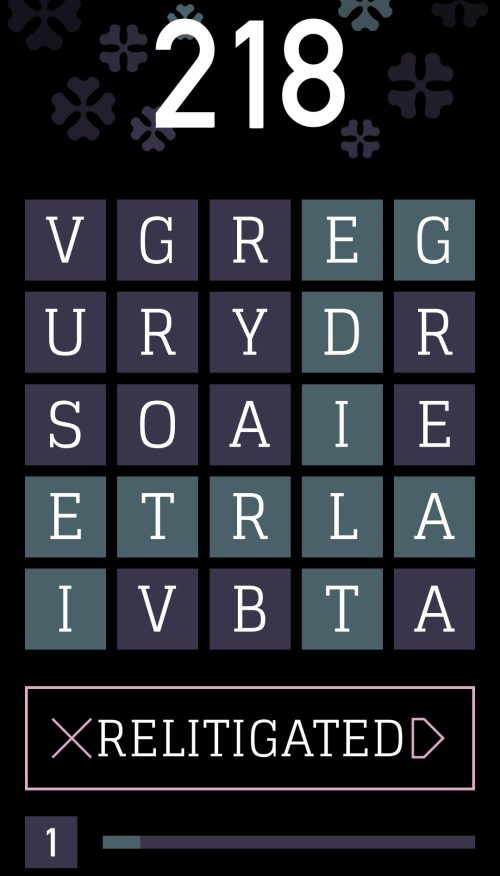
First, find a word that blocks each row and column, then pin that word using long-press. The point, here, is to prevent any row and column being cleared, so you can clear the whole grid with a single word and earn the maximum 109 points. This was usually my longest word on the grid.
I would then attempt to clear the rest of the grid in just three words. Sure, if I could do it with two, that would be totally awesome but dream on, folks.
Clearing the grid was often hard. I’d find myself struggling to find words which perfectly partnered to clear the board. And then I’d get boards which had skewed vowel/consonant ratios which meant I also needed words with skewed V/C ratios. A reasonable words like REASONABLE would be an unreasonable disaster because a V/C ratio of 1:1 would plunder a skewed board for practically all the vowels or consonants.
Too many vowels? Look for words with a nice AURA or maybe cry out BOOHOO and hope the board shows compassion. Against an army of consonants, however, you needed a KNIGHT in reserve.
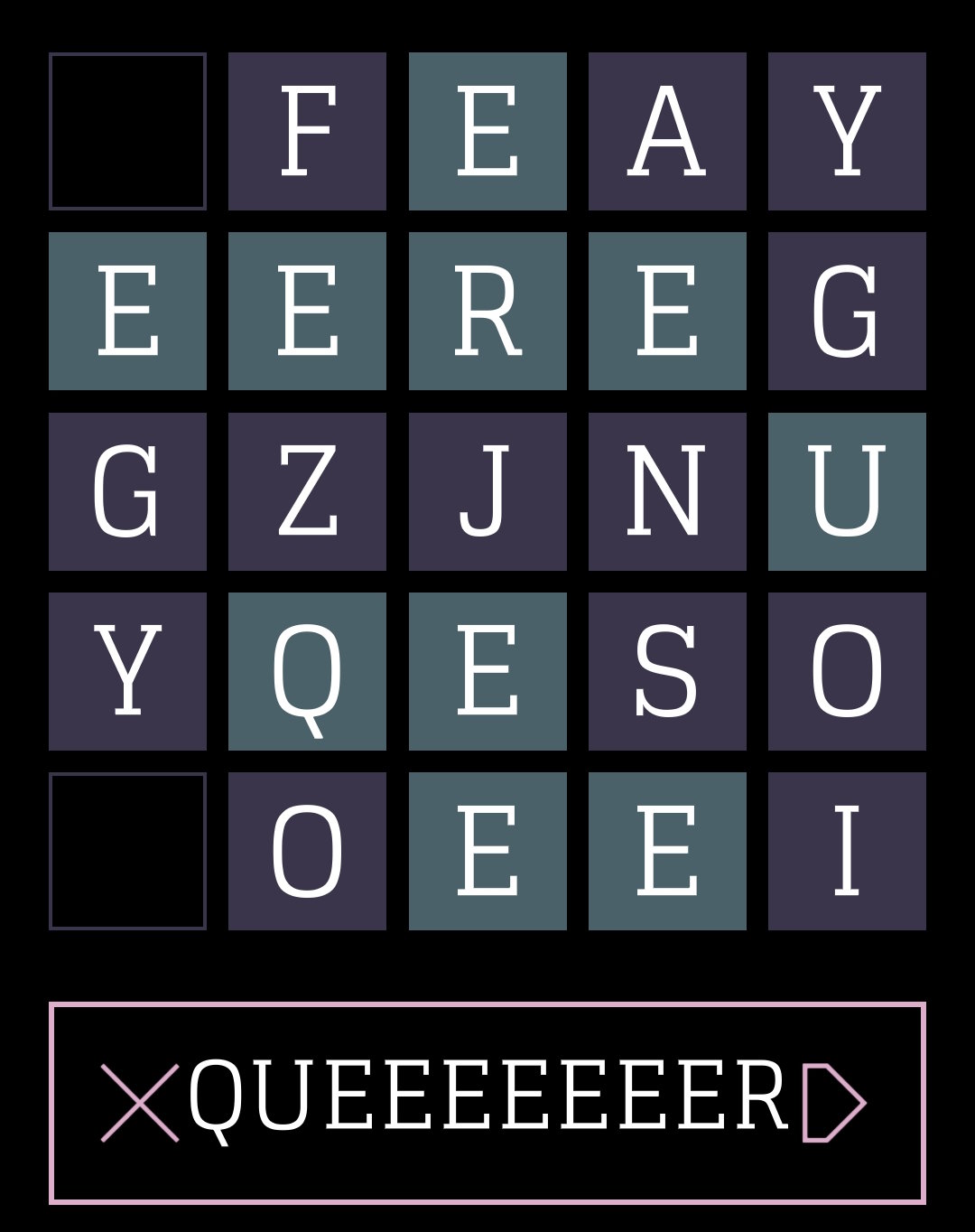
Sometimes I’d punch in random words if I had an odd sprinkling of letters left over and this ploy occasionally got me out of dodge. I think one of the last boards I played was sealed with FE.
There were two situations in which I would defer to a dictionary:
- I had a word but my brain cache was unsure about the spelling, putting the grid in JEOPARDY.
- I got a Q without a U. Sometimes I’d peel off a row or column, run an exploratory game, to see if a U was just around the corner. Usually it wasn’t, and I’d just have to play the naked Q, looking up words such as QAID and NIQAB.
Once I’d cleared the board in four moves, I’d have to do it all over again with a new board of letters.
THE STRUGGLE IS REAL
In theory, this meant my score would always be 218 + whatever I could squeeze out of a third board in two moves. But I was not always able to blow away a board in four moves, which limited the potential on that third board. I remember one blessed day having three moves remaining yet still finding it impossible to generate mega points from the third board – and that luck felt entirely wasted.
When I first played DWG, I would just bang in the words. After I bigged up my strategy game, I always pinned the clearance word and typed out all the potential words at the same time, filling the input box with HUNDREDBEIGEOBELISK to make sure I had exhausted all the letters. But sometimes, I’d make a mistake, my eyes sliding off ICY when, in fact, the letters remaining were IICY.
Also there were some shocks where I set myself up with a word like FLATOUT or RELITIGATED only to discover DWG wagged it’s finger at me like Robert Patrick’s T-1000 in Terminator 2.

I made a rule of not using anagram solvers except in one special situation. You would not believe the number of times, when my train commute was coming to an end, that I had to enter the pinned word but could not remember what it was. I had to stick it in an anagram solver quick sharp to recover my own memory!
I did wonder if it was possible to cheat using an anagram solver. As an experiment, I re-attempted a difficult board with an anagram solver at my side. I promised myself not to commit the tool-assisted score if it was higher than my human-brain score, but I didn’t need to worry. With my clearance word approach, I had exactly the same problem of trying to find the right words that interlocked and cleared the board. I found more words, but it didn’t accelerate the process.
HANGING UP THE SWORD
Sure, I got that decent position on the monthly board. But the only reason I earned that high score position was being indefatigable. Some players would consistently bang out a better score than me, but because they did not play every day, they slid down the monthly leaderboard. I played every day and had to work hard for a score north of 218 points.
And the truth is I didn’t feel like I was actually good at DWG. Let’s digress.
When I lived in Japan circa 2000, not only was I practicing Japanese much of the time, but I would dumb down my English to make sure I didn’t poison communication with unfamiliar English words or idioms for my Japanese counterparts. After five years in Japan, I found my writing skills had collapsed – I just lost the knack for assembling bright metaphors or digging up the key words necessary to make the writing more colourful.
I kept at it and threw myself into book reading – in time the word wheels felt greased again. I attended a writing group where we’d share our humble creations. And, eventually, I launched Electron Dance.
But in recent years, my reading has been in sharp decline across the board. I barely get through a single book in a year and even my web reading has dwindled, opting more for podcasts or YouTubes. Writing for Bivium made this more painfully obvious than writing for Electron Dance and DWG just brought this all to a head.

Because to make those scores on DWG I was often spending an hour or more every day and that seemed ridiculous to me. I even lost time that had been designated as a Bivium writing period because I was stuck in a chair wrestling a DWG board to clearance. My scores did not represent genius word recall – just the ability to sink time into it. And if I wanted to make my word recall better, it would probably be more constructive to use the same amount of time to read a book.
So, I decided that after March’s challenge concluded, I would retire from DWG. I still love the game but, if there’s one important thing DWG has taught me, it is that I really should start reading again.

Download my FREE eBook on the collapse of indie game prices an accessible and comprehensive explanation of what has happened to the market.
Sign up for the occasional Electron Dance Newsletter and follow on Bluesky or Mastodon!